Advocacy by Daly John
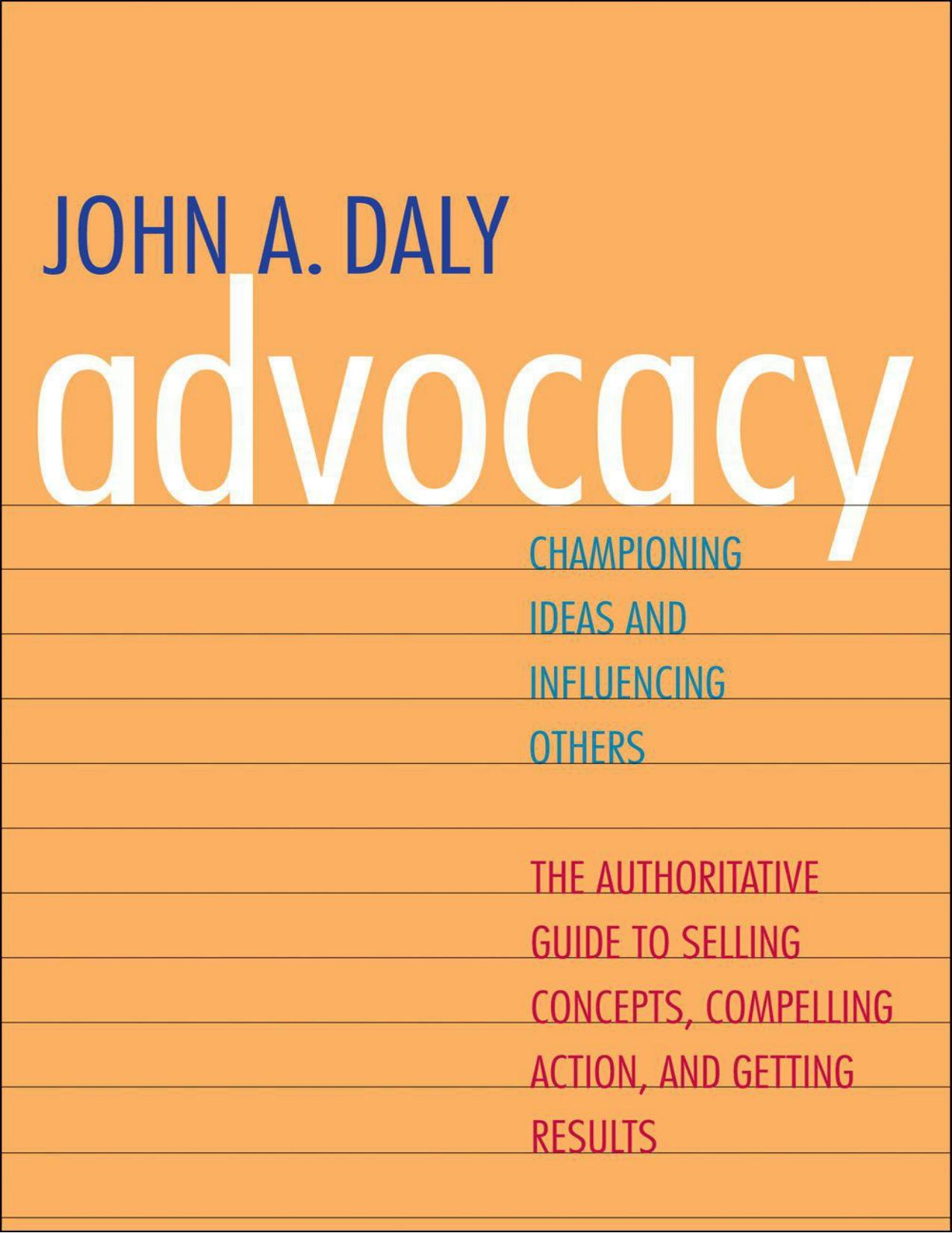
Author:Daly, John [Daly, John]
Language: eng
Format: epub, pdf
Publisher: Yale University Press
Published: 2011-08-29T14:00:00+00:00
• disasters and near disasters
• failures of other initiatives
• external crises
Charles Darwin published his epic work on evolution only after discovering that Alfred Russel Wallace planned to publish a paper making claims that Darwin believed he himself had discovered much earlier. When a competitor was ready to launch, Darwin responded. To stop the search for perfection and move forward is a typical response when faced with competition. Pharmaceutical companies know that a major motive for physicians to adopt new drugs is their informal competition with other doctors—if a physician down the street begins to prescribe a new drug, then maybe they should, too.16
In successful organizations, when decision makers sense that competitors are vigorously working on new initiatives, they are more open to ideas related to those issues than if no change were on the horizon.17 Competitors motivate innovations. When Tesla Corporation introduced an electric car in 2008 that could go from zero to sixty miles per hour in less than four seconds and travel for more than 240 miles without recharging, Bob Lutz, then the vice chair of General Motors, said, “All the geniuses here at General Motors kept saying lithium-ion technology is ten years away, and Toyota agrees with us—and boom, along comes Tesla. So I said, ‘How come some teeny little California start-up run by guys who know nothing about the car business can do this and we can’t?’ That was the crowbar that helped break up the logjam” that had prevented creation of an electric car at GM.18
A change in competitors also creates opportunities to promote ideas. When new competitors enter the market, everyone else starts worrying about what the new kids on the block will do. This can provide a golden moment to propose a product or service that might differentiate your firm from others. In the 1940s the typical rollout of a new Procter & Gamble product took two to three years. Procter & Gamble had a logical, well-defined process that it methodically applied to every innovation. But when some company scientists created Tide and wanted to speed up the rollout of that innovative detergent, they urged executives to eschew the established process because competitors like Lever and Colgate would soon enter the same marketspace, and any advantage for Procter & Gamble would be lost. That argument won the day, and the company speedily took Tide to market.19
Lyndon Johnson famously advised that you should never give a man a present when he is feeling good. Instead, wait until he feels bad, when he will treasure the gift. Johnson was right. New ideas get traction after bad news or failure, after disaster or near disaster.20 Here are a few examples.
Benjamin Franklin invented the lightning rod. But after enjoying some early success, the idea that you could prevent fires by sticking a piece of metal to the top of a building and stringing the metal to the ground fell on tough times. In fact, some people believed these rods would cause earthquakes by putting lightning into the ground.
Download
This site does not store any files on its server. We only index and link to content provided by other sites. Please contact the content providers to delete copyright contents if any and email us, we'll remove relevant links or contents immediately.
Nudge - Improving Decisions about Health, Wealth, and Happiness by Thaler Sunstein(7712)
Deep Work by Cal Newport(7092)
Principles: Life and Work by Ray Dalio(6466)
The Doodle Revolution by Sunni Brown(4772)
Factfulness: Ten Reasons We're Wrong About the World – and Why Things Are Better Than You Think by Hans Rosling(4747)
Eat That Frog! by Brian Tracy(4547)
Thinking in Bets by Annie Duke(4233)
Hyperfocus by Chris Bailey(4128)
Visual Intelligence by Amy E. Herman(3789)
Writing Your Dissertation in Fifteen Minutes a Day by Joan Bolker(3733)
Ogilvy on Advertising by David Ogilvy(3631)
Hidden Persuasion: 33 psychological influence techniques in advertising by Marc Andrews & Matthijs van Leeuwen & Rick van Baaren(3570)
How to Win Friends and Influence People in the Digital Age by Dale Carnegie & Associates(3568)
How to win friends and influence people by Dale Carnegie(3480)
The Pixar Touch by David A. Price(3444)
Schaum's Quick Guide to Writing Great Short Stories by Margaret Lucke(3384)
Deep Work: Rules for Focused Success in a Distracted World by Cal Newport(3242)
Work Clean by Dan Charnas(3131)
The Slow Fix: Solve Problems, Work Smarter, and Live Better In a World Addicted to Speed by Carl Honore(3015)
